

I get wrapped up in cutting edge geospatial stuff.

You know, the new stuff: foundation models, world models, non-GPS navigation, swarms of satellites. Literally anything Sean Gorman is doing (whether I understand it or not).
I know, it’s a problem I have. I have built a team around building very practical, yet innovative technology. We do this crazy thing where we deliver cutting edge technology to schedule and within budget. The idea was to bring geospatial technology to those who were missing it, and bring it at scale. In general, the geospatial industry is both siloed and somewhat proud of it. So being a technology bridge makes some (niche) sense.
But, the problem is. When you are always trying to be innovative, you are always kinda early. Early is a complicated term, and it sits on a scale for everybody. I’ve talked about S-curves before, and that is a great way to visualize the growing efficiency or effectiveness of a particular technology or process. The idea is that a new technology starts being low efficiency, a few end up buying-in, early adopters you might call them. As the technology is worked on, it gains efficiencies to reaching a linear efficiency growth by this point a bigger customer base creates a bigger market. Eventually, the technology’s efficiency will taper off as physical or practical limits are reached, resulting in the top right of the curve.
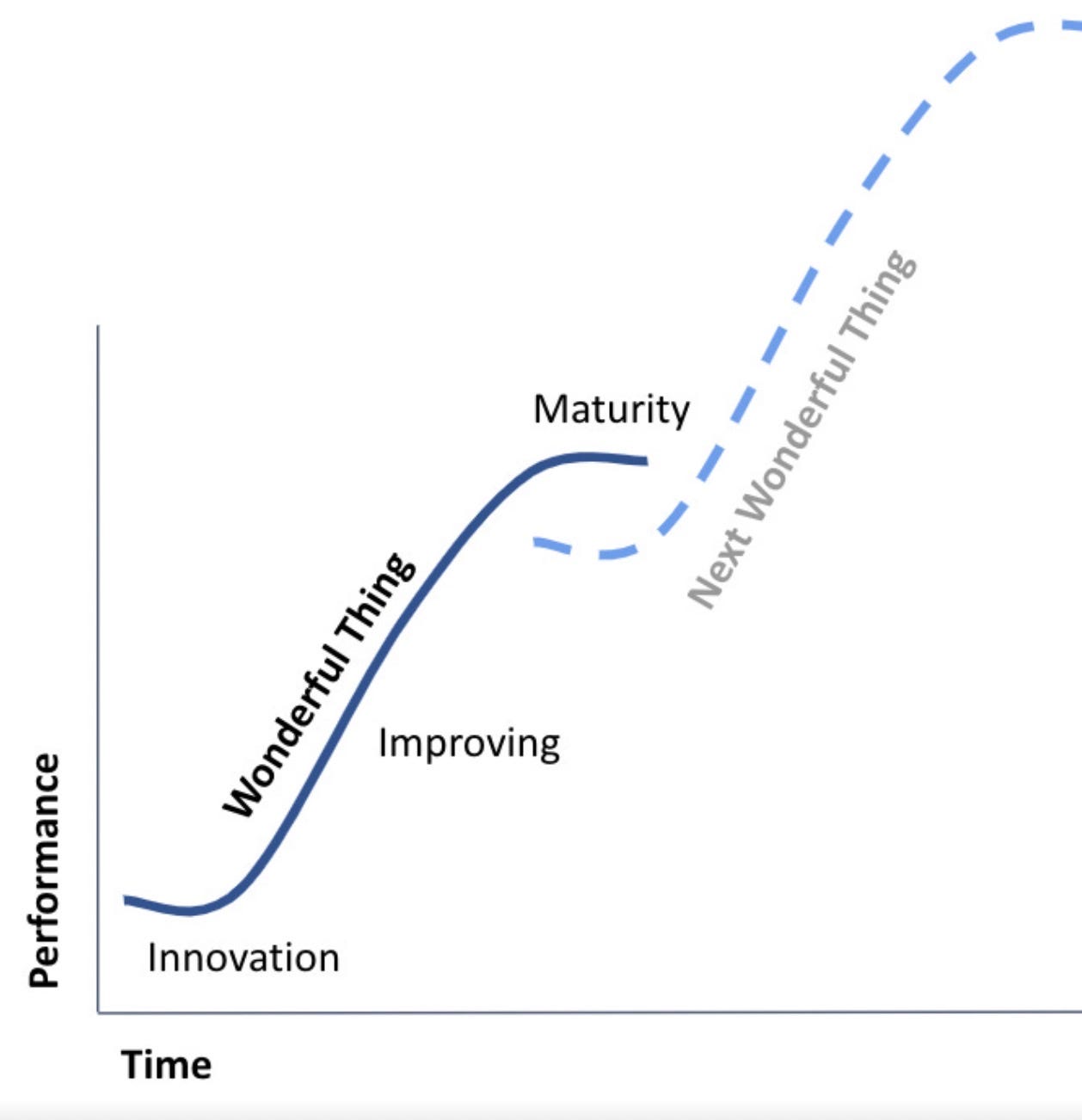
Ok, it’s not really an “S”, but you get it.
When you are always trying to do something new, you end up sitting somewhere early on the s-curve. Often this is when the technology isn’t that good yet. So, a major component of my and my team’s time is spent trying to figure out “what’s good.” What is worth pursing more, what effort we can leans a little weight to, and what might fit a particular need. Or, when something is good enough for a particular customer profile.
Because, the other critical component is that idea of needs. The needs of a customer or customer vertical is also a moving target. In fact, I think of customers as sitting on their own s-curves. By that, I mean that customers, corporations, or people, for that matter, are all ready for new innovations at their own particular time. This timing is harder to measure, because it can be as much about the personality of a particular corporate champion, or the industrial ecosystem than anything. It’s also important to think about timing in terms of presenting new ideas in sequence.
For instance, AI projects these days are lighting up numerous boardrooms, but the technology is still a touch early for most major enterprises. I reflect on how long it took for most major institutions to adopt cloud technology (decades), and how quickly AI has become a critical entry in every earnings report (months). In terms of timing however, cloud approaches (not necessarily just the Hyper-Scalers, but the use of cloud-native methods) have opened the door to meaningful AI activity, that’s the sequence. Again, think about complementary assets providing direction for the sequence.
The problem is a matter the precise coordination of two timelines against the inconsistent backdrops of corporate performatism and geopolitics.
In many ways it’s an art.
Being is early is a puzzle. Today, it seems to be even more confusing, yet even more important to be early. More important for more people. So today, it’s increasingly critical for grounded, experienced technologists to provide good advice on what’s worth pursing.
So, be early, before it’s too late.