

Data is not oil
I don’t like the idea that “data is oil.” I think it’s a trite analogy that has been weakened by its demonstrable failure to deliver. Not that data isn’t valuable, but the idea that there is a global price for data and that everyone’s data is inherently valuable to others doesn’t make sense. This is all the more true with Earth Observation (EO) data and many sources of geospatial data. Data is valuable, but only to those who know how to use it.

I would also treat those who know how to use a particular type of data and those who know the value of a particular piece of data as two separate, often immiscible groups. Boffins can, but often don’t, mix with the business people.
However, I do believe completely that data has value. In fact, as I often repeat, investing in data is like buying a house, while investing in technology is like buying a car.
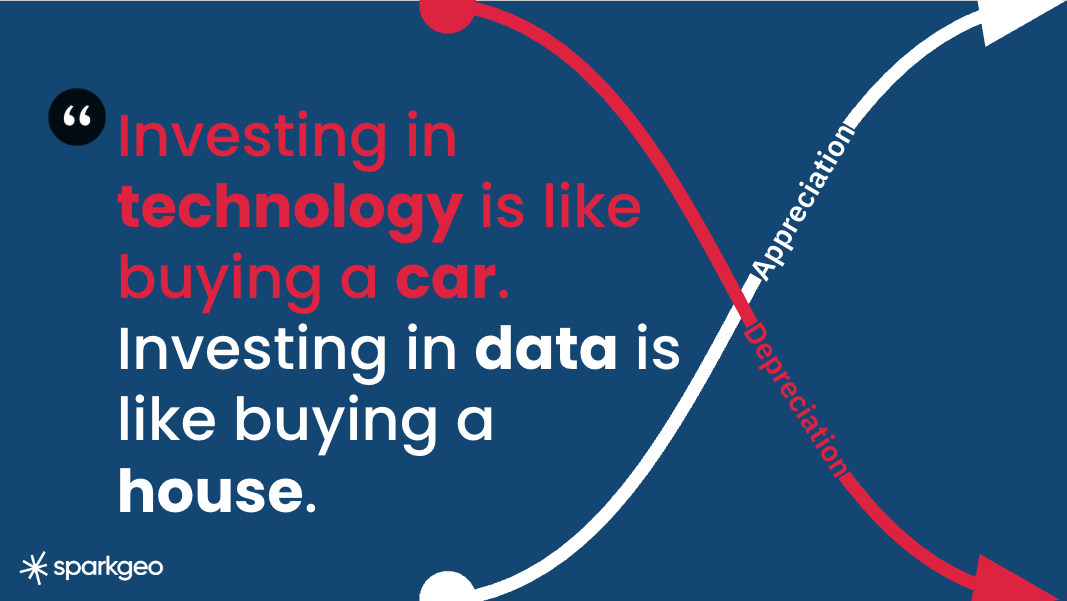
What I am saying is that User Interface (UI) technology is evolving so quickly that it's not worth spending too much extra money on, whereas data is a moat that can protect your enterprise in ways you probably don’t fully understand yet. AI, as yet, cannot create data. Well, it can make things up, but at this point, AI still relies on actual sensors to measure and monitor.
But what this diagram misses, but the “data as oil” cliche points to, is the notion of a “midstream.” The oil and gas sector is very familiar with the upstream, midstream and downstream components of their market. This pattern is very analogous to what we see in the Survey, EO, and IoT sectors. In fact, in many ways, where we are with EO data is even better, albeit more complicated than that of the cruder resource.
Data as a resource
Interestingly, at least in the EO sector, we often talk about upstream and downstream components. But we rarely talk about the midstream's differentiating power. Yet I would argue that the midstream, the distribution of data, is the critical element that creates a functioning market.
The wonderful difference between data and crude oil is that data can be used more than once. This is especially true of geospatial data. Geography is a critical component of many business processes, so a single point of interest, or pixel, could be used in numerous different ways, numerous times. Obviously, once a barrel of oil is fractionally distilled, it will be consumed and not reused. It’s a famously non-renewable energy source. So data, if stored appropriately, can serve as a critical reservoir of opportunity that can be tapped without ever actually emptying. Of course, the market demand for a data product will likely grow and flow, but the opportunity remains. And as we know, new technologies can create new market opportunities by enabling the development of complementary assets. Thus, a dataset which was once inaccessible and awkward can suddenly become accessible and valuable with a complementary asset. This asset could be a handy open source library, a new algorithm, a new approach to computing, or AI.
The key here, then, is the engineering which makes data accessible. In some ways, the hyperscalers have shown a pathway to market. Additionally, standards play a role: the value of SpatioTemporal Asset Catalogues and published metadata cannot be underestimated. But so often geospatial workflows and markets are bifurcated, not trifurcated (if that’s a word?) The implicit expectation is that the midstream is being “taken care of” by either a satellite company or an analytics company, or the respective units within a single entity. That there is some kind of “interface,” ideally an API, which solves all problems. The reality is a lot messier.
The S word
It gets even messier when we start to consider sovereignty. This word is being redefined every couple of hours on various social media channels. But if one is interested in streaming data from one’s own satellite or sensor, one should probably own the midstream software and infrastructure and that infrastructure should probably be in a place that one can protect in some manner. Without owning the midstream, there is no sovereignty. But with the advent of different providers offering sovereign capabilities, what kind of SLA allows for IP ownership to a country or organization? Interestingly, as we are seeing in the AI debates, the answer lies in sovereign deployments of open-source technology.
But that is missed. In the desperation of EO companies to show value and create insight. The midstream is mishandled, the opportunity for foundation models is squandered, and ultimately, the Sovereign question becomes a series of one-off engagements which become an operational nightmare, rather than a robust market opportunity.
Over the next few weeks, I will be digging into the EO and geospatial midstream markets. I will be thinking about why some companies separate out their operations (Maxar to Vantor and Lantaris, Hexagon spinning out Octave), and some want to vertically integrate (MDA pulling in CLS, ). We will be thinking about the midstream concept and what it takes to build data infrastructure. Why the idea of “Spatial Data Infrastructure” is useful, but probably getting a little stale.
YOURS,
In The Middle